
Roundtable «Rus in the History of Ukraine: How Should Museums Present It?» Held at the Museum
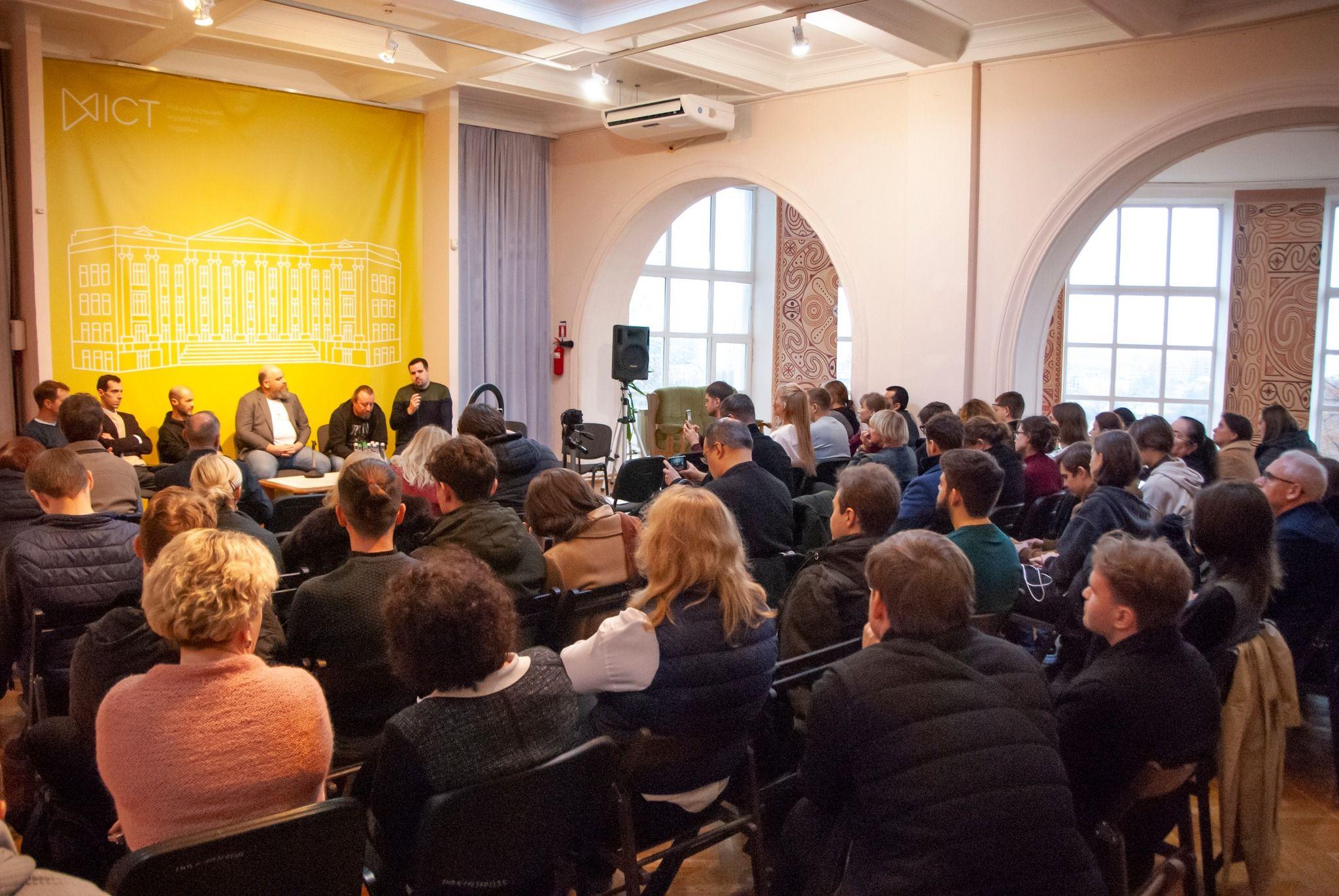
On 12 November 2025, the National Museum of the History of Ukraine hosted a roundtable titled «Rus in the History of Ukraine: How Should Museums Present It?».
The meeting focused on contemporary interpretations of the history of Rus and its role in Ukrainian state formation. This topic is of exceptional importance during the full-scale war, as the enemy manipulates this historical narrative to justify its aggression. The aim of the event was not only to develop a scholarly, well-grounded response, but also to ensure its effective communication, particularly through museum practice.
The discussion was opened by Bohdan Patryliak, Deputy Director General for Research at the NMHU. In his introductory remarks, he stressed the significance and urgency of addressing this topic, as our medieval history faces extensive falsifications and mystifications.
The discussion was moderated by Vadym Aristov, PhD in History, Research Fellow at the NMHU and Senior Research Fellow at the Institute of History of Ukraine of the National Academy of Sciences of Ukraine. He emphasised that the conversation concerned ways of thinking about the past: «This discussion is not limited to adapting scholarly knowledge to a popular format. It is not only about words, but also about the ways in which we think about the past. And it is very important to keep a clear head and, on the one hand, not fall for hostile myths and manipulations, and on the other hand, not create our own myths in their image and likeness, which obscure the historical reality from us».
One of the central issues for the organisers concerned the use of the terms «Ukraine» and «Ukrainian» in reference to the ethnocultural and political realities of the 9th–14th centuries. In the participants’ remarks and in the subsequent discussion, it was emphasised, on the one hand, that the authentic term for this period is «Rus» and its derivatives, and on the other hand, that there is a need to express the direct ethnical continuity between the population of the Old Rus period and modern Ukrainians through the use of «Ukrainian terminology». In addition, all roundtable participants were unanimous in understanding (Old) Rus as an integral and indispensable part of Ukrainian history — both in the broad state-territorial sense and in the narrower ethnocultural sense.
Yevhen Synytsia raised the question of how we conceive of the state: «Unfortunately, from school onwards we accustom ourselves to the idea that the history of states is the history of princes and heroes... Yet we constantly forget that a state is a function of society, not the reverse. It is neither needed nor emerges simply because some outstanding individual wished to be a state-builder and decided that there should be a state here». The scholar also stressed the distinction between genuine scholarship and pseudoscience: «True scholarship differs from pseudoscience in that at a certain point it says: “This we do not know” or “This we do not yet understand. We lack sufficient data”».
Viacheslav Baranov outlined the relationship between academic scholarship and museum practice: «On the one hand, academic scholarship and museum work must be distinguished, for they pursue different aims and tasks; on the other hand, museums must, of course, be guided by the current achievements of academic scholarship», and continued: «And we must not allow museums to create myths. A museum must communicate scholarly knowledge. If scholarship does not provide an answer to a particular question, the museum has no right to invent one».
Historians Taras Pshenychnyi, Vadym Aristov, Yaroslav Zatyliuk, and Tymur Horbach, as well as archaeologists Vsevolod Ivakin, Yevhen Synytsia, and Viacheslav Baranov took part in the professional discussion.
The participants addressed a wide range of topics, including debunking historical myths about Rus, discussing money and religion in the Old Ruthenian period, the analysis and refutation of propagandistic clichés of the aggressor state, the appropriateness of various historiographical names for Rus, the role of museums in popularising history among children and adults, the challenges faced by regional institutions, and many other engaging subjects.
A detailed summary of the discussion, along with recommendations from museum professionals and historians from leading specialised institutions of Ukraine, will be published later in a separate museum release. In the meantime, we invite you to watch the full discussion on the YouTube channel of the National Museum of the History of Ukraine: http://www.youtube.com/watch?v=LrdtHGB2P2w.
The museum serves as the organiser of a series of discussions on this and other compelling topics. The next event planned is a roundtable on the same theme featuring linguists and literary scholars.


